Anyone can become a top 3% chess player.
"You already know how the pieces move."
You've played hundreds of games. Maybe thousands. You've watched YouTube videos, done puzzles on chess.com, picked up a few opening lines. You can beat your friends. You understand when something goes wrong, even if you can't always explain why.
But your rating has been stuck in the same range for months. Maybe longer.
You're not getting worse. You're just not getting better. And nobody seems to be able to tell you exactly what to do about it.
How it works
No dry notation. No endless opening theory. No 400-page books full of variations you'll never play. Just clear, concept-driven lessons built for how people actually learn — quickly, visually, and with enough momentum to keep going.
Start in minutes
Pick your level and dive into your first lesson. No theory preamble, no jargon. Just chess — one concept at a time, on any device, whenever you have five minutes.
Build the habit
Short daily sessions, streaks that reward consistency, and a badge system that makes progress feel real. You'll want to come back tomorrow.
Watch your Elo move
Connect your chess.com or Lichess account and track your actual rating alongside your curriculum progress. The goal isn't just to learn chess — it's to play better chess.
"I'm not a chess prodigy. I want to be upfront about that."
I don't have a coach. I've never played competitively. I'm not a titled player and I have no plans to become one. I'm an amateur — a hobbyist who picked up chess because it's one of the most interesting games humans have invented, and who got genuinely frustrated when improvement felt random and slow.
I had the same problem you probably have. I consumed a lot of chess content — videos, puzzles, opening guides — without a clear sense of what I actually needed to learn and in what order. Chess has infinite content. Almost none of it is organized for someone at my level.
So I went looking for structure. I read. I studied. I tracked what actually moved my rating and what didn't. I collected the concepts that mattered, stripped away everything that didn't, and built myself a curriculum.
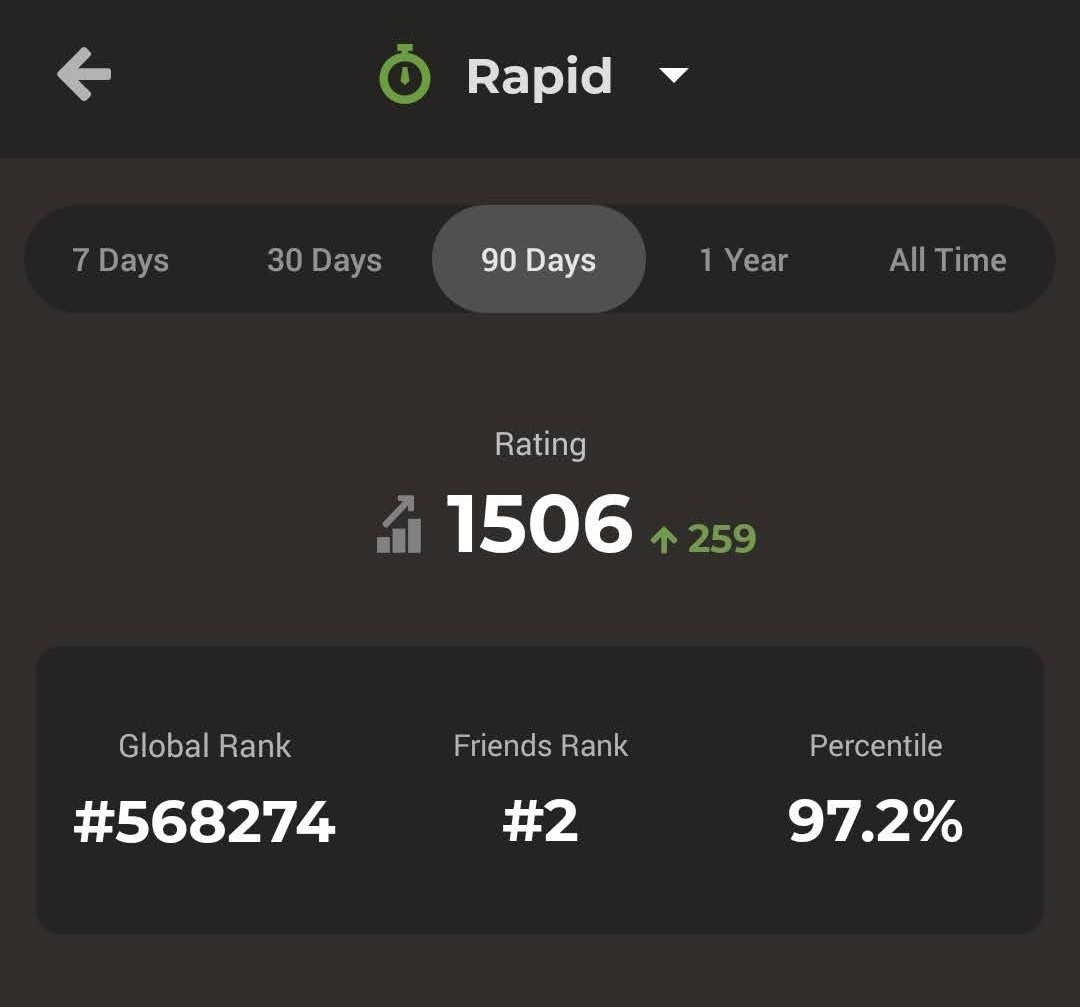
That's my rating over there. 97.2nd percentile. Top 3%.
I'm not telling you that to brag. I'm telling you because I want you to understand what that number represents — it didn't come from talent. It came from learning the right things in the right order, consistently, over time.
And I want to be completely honest about something: this won't make you a grandmaster. It won't make you a titled player. But top 3%? That's a level where you genuinely understand chess. That's attainable. I know, because I'm there — and I'm still a normal person who fits chess into a normal life.
Real user. Real progress.
Why this works
You don't need to learn from grandmasters.
The people who are best at chess are often the worst at explaining it to beginners. Not because they don't care — because they've long forgotten what it's like to not understand it. This is the curse of knowledge. The gap between their level and yours is so vast that their explanations skip over the exact things you need.
The knowledge has never been more available. That's not the problem.
Chess engines changed everything. For the first time in history, anyone with an internet connection has access to the strongest chess player that has ever existed — something that can tell you with certainty whether a move is good or bad, and let you explore exactly why. Chess.com has surpassed 250 million users. There has never been more chess content, more streamers, more tutorials. Access to information is not your problem. Structure is.
I have something a grandmaster can't give you: beginner's mind.
I'm a top 3% player, but I'm still a learner. I still have good weeks and bad weeks. I can still remember exactly what it was like to sit where you're sitting — because I'm not that far from it. I took everything that actually matters to get from stuck to top 3%, stripped out everything that doesn't, and organized it into lessons you can do in five minutes a day. Not looking down from 2700 Elo trying to remember what confused me a decade ago. One level ahead, looking back, describing exactly what I see.
The curriculum
25 courses · 140 lessons · 661 cardsStart with the free tracks. Make real progress. Unlock Pro when you're ready.
Imagine finishing the free curriculum. You've worked through 10 courses — roughly 300 cards. You've covered every fundamental: piece activity, tactical patterns, opening principles, pawn structure, basic endgames. You understand concepts that most casual players never formally learn.
You sit down for your next game. You recognize the opening. You know what you're trying to achieve before the middlegame starts. When your opponent makes a mistake, you see it — and you know how to punish it.
That's not a fantasy. That's what a structured curriculum does. It replaces guesswork with understanding.
"If you do your first lesson and don't feel like you learned something real, you've lost five minutes. That's the entire risk."
No credit card. No account required. Free tracks never expire.
Questions
Everything you need to know before you start.